

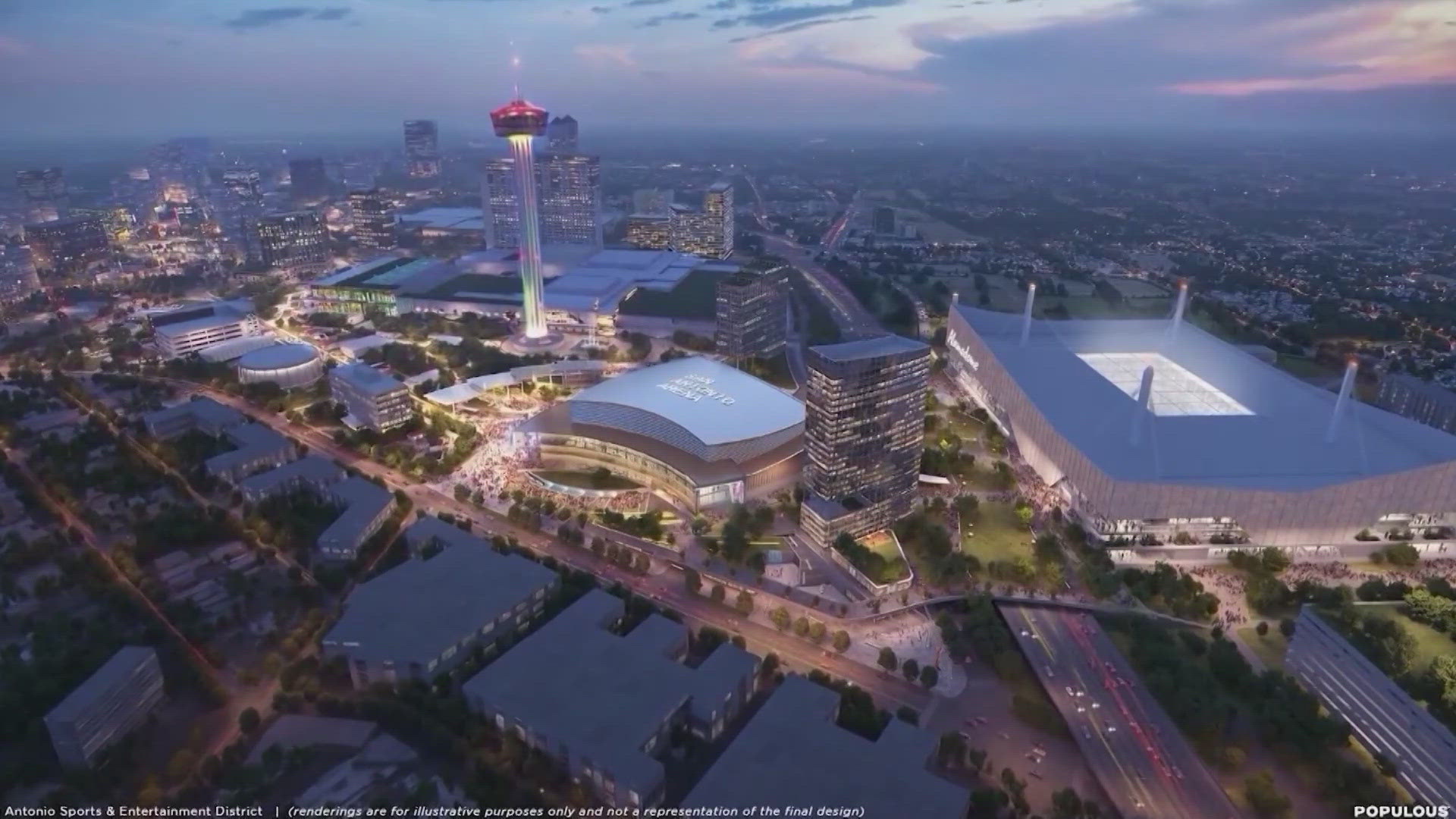
SAN ANTONIO — With the new year comes new conversations for San Antonio leaders as they continue marching towards breaking ground on downtown's next chapter—specifically, the construction of a new Missions baseball stadium, a $1.3 billion Spurs arena, and other major development.
City Council will vote Thursday on authorizing staff to purchase the federal office building at 727 East Cesar E. Chavez Blvd., as well as the surrounding lots for $30 million. That money would be provided by the Spurs, which would help create the mixed-use development intended to help support their new Hemisfair home.
Before that vote, council members heard directly from city staff on Wednesday about 2026's priorities regarding Project Marvel – comprised of multiple key projects – and the new Missions stadium, which are set to reshape the heart of San Antonio in the coming years.
“We all recognize this is a generational investment, but also a wonderful opportunity," Mayor Gina Ortiz Jones said at the briefing. "Downtown can be much more of a strategic economic engine than it currently is. Now is our opportunity to shape that.”
Here's where things stand for each project.
Building a new Spurs arena
Plans to build a $1.3 billion home for San Antonio's biggest professional sports franchise got a jolt of momentum when Bexar County voters approved a funding framework in the November election. So what's next?
City staff are seeking City Council's approval to buy a federal office building and nearby lots in the Hemisfair area. The roughly 5.7 acres of land would house some of the residences, businesses, office space, and other development comprising the future downtown sports and entertainment district.
The price tag: $30 million, plus an estimated $120,000 in closing costs. That money would be provided by the Spurs, on top of the at least $500 million the team has committed towards construction of the arena. Council is schedule to vote Thursday on authorizing that purchase.
Meanwhile, the former home of the Institute of Texan Cultures – a museum that was razed last summer – still belongs to UTSA. But the City of San Antonio holds the exclusive first option to purchase the roughly 13-acre parcel of land, and officials say they'd like to have it acquired by the end of the year.
“We have not had any recent conversations with them about the acquisition of this property," said Ben Gorzell, chief of financial and administrative services for the city. "So we need to re-engage on this effort.”
City officials say they were previously told it would cost an estimated $60 million to buy the land, but both the city and UTSA will complete their own appraisals in the coming months.
But local officials must still go through a range of negotiations before ground on the arena is broken, including coming to detailed terms on aspects like community benefits, design and construction, and economic development. The city hopes to have "substantive" negotiations wrapped up by Dec. 31.
Expanding the Gonzalez Convention Center
Previously identified as a priority component of Project Marvel in order to remain competitive with other cities sprucing up their own conventions facilities, San Antonio officials hope to present an updated feasibility study on the venture to council by September.
“We want to look at market analysis again, we want to make sure we’ve got our space requirements right, we want to look at accessibility to the park," Gorzell said.
Reimagining the Alamodome
Plans to bring the Alamodome into the 21st century have always been considered a latter-phase project of the sports and entertainment district. City officials are sticking to that, saying the "reimagining" of San Antonio's biggest venue – home to UTSA football, the Final Four when it visits San Antonio and major concerts – will likely hit full throttle a decade from now.
In the meantime, officials say they will prioritize ensuring the Alamodome receives the "operational capital" it needs to continue drawing in big crowds and headlining events.
Building a land bridge
As city officials put it, the plan to build a walkable, ecofriendly land bridge over Interstate 37 along the eastern edge of downtown is "unlikely at this point in time." It had previously been considered a key Project Marvel element to reconnect downtown with the east side.
At the same time, officials said they still want to explore connectivity options, an opportunity afforded to the city through a $2.96 million federal grant. Alternatives to a land bridge that could come to fruition: new sidewalks, bike paths or a pedestrian bridge.
"We have until the end of this calendar year, Dec. 31, to spend it," Gorzell said, adding the grant's total available funds could go up to $3.7 million.
Councilwoman Phyllis Viagran, who referred to the land bridge as a personal priority in Project Marvel discussions, said she wants walkability to remain at the forefront. She also said she didn't want the sports and entertainment district to overwhelmingly dominate city staff's time in 2026.
“We have got projects in different district around this city," Viagran said. "I do not want this to be the only show we discuss in B-sessions and executive sessions.”
Building a new Missions baseball stadium
The baseball stadium expected to go up near Fox Tech High School in the northwest corner of downtown is on a "more definitive timeline," per city officials. The San Antonio Missions, the Double-A affiliate for the San Diego Padres, want to be in their new home by spring 2028.
It's expected to cost $160 million to build.
City officials plan to have a financial framework presented to council members in June, with details on the city and county funding portions of the stadium completed by July.
What about parking?
Parking is also in the spotlight for not only city leaders but San Antonians wondering where they can leave their car while enjoying the downtown district to come.
City Council was briefed last summer on a potential laundry list of changes to accommodate for what would be a huge influx in visitors, including a new parking garage, a modernized intersection by the Alamodome to cut down on traffic, a new highway on-ramp to I-37, and more park-and-ride opportunities on public transit.
All that would require calling an infrastructure bond election. The city hopes to hire a consultant to provide a more detailed look at what's possible this year.
Councilwoman Sukh Kaur, whose district includes downtown, said addressing parking needs to be a priority.
"The amount of times I hear, ‘Oh, there’s no place to park,’ but we have so many surface parking lots, it’s insane that we don't really even need them," Kaur said, suggesting an online tool allowing residents to see all available parking. "We want to build a downtown where our residents want to come down to as well and don’t feel it a burden."